
Home
Services
Products
Projects
Who We Are
Blogs
Contact Us
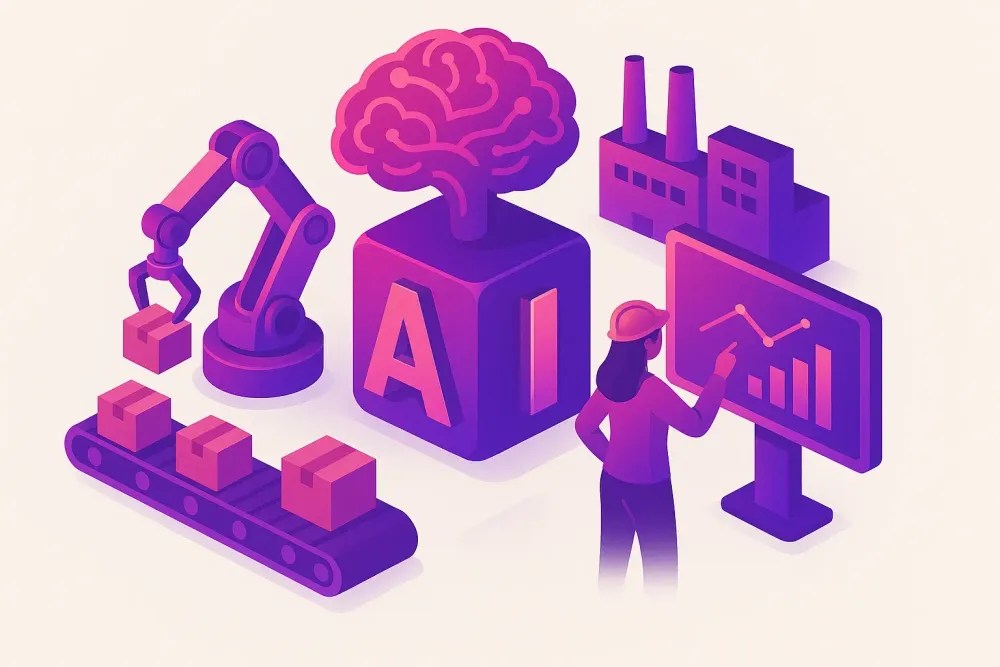
Revolutionizing Manufacturing: How AI is Reshaping the Industry
Artificial intelligence (AI) is rapidly transforming the manufacturing landscape, offering powerful tools to streamline processes and reduce human workload across the industrial spectrum. Traditional manufacturing organizations are increasingly adopting AI and machine learning (ML) models to optimize efficiency and significantly reduce costs.
While established manufacturing processes have been meticulously refined over decades, recent advancements in AI—particularly machine learning—have unlocked unprecedented opportunities for further optimization. The integration of AI allows for the replacement of suboptimal performance with precise, data-driven results. AI application development enables the creation of sophisticated models that leverage data from diverse sources, including raw material composition, quality assessments, and sensor readings from a vast array of devices. This article delves into the transformative role of AI in manufacturing and explores its profound impact on the industry.
What Is the Role of AI in Manufacturing?
The core function of AI in manufacturing centers on minimizing downtime and ensuring the continuous operation of production lines. The combined market value of AI and manufacturing exceeded USD 1 billion in 2018, with projections indicating a 40% compound annual growth rate (CAGR) between 2020 and 2025 (Global Market Insight). This surge in adoption is fueled by substantial venture capital investments in AI-driven manufacturing solutions.
When an ML model identifies anomalies during operations or detects trends suggestive of equipment malfunctions, it applies predictive intelligence to determine whether human intervention is required. AI-powered manufacturing models can accurately predict when production lines need to pause or slow down, enabling timely maintenance and preventing costly disruptions until replacement parts arrive.
Leveraging AI in manufacturing translates into data-driven decision-making that can save hundreds of thousands of dollars in production costs and significantly reduce plant downtime. AI-powered predictive maintenance capabilities forecast the need for replacement parts, reducing machinery downtime and preventing unnecessary inventory accumulation. By analyzing vast datasets, machine learning algorithms identify patterns that indicate potential part failures—allowing maintenance and repairs to be scheduled at optimal times.
As AI systems evolve and refine their predictive capabilities, their value to industrial businesses grows exponentially. Machine learning development services empower manufacturers to build increasingly accurate predictive models, continuously enhancing their ability to anticipate and address potential problems.
What Are the Benefits of AI in Manufacturing?
- Enhanced Safety: Manufacturing remains one of the most hazardous industries. AI-powered robots can assist in high-risk tasks, reducing the chances of accidents and serious injuries.
- Cost Reduction: AI-as-a-service introduces multiple avenues for cost savings by improving analytics, optimizing resource allocation, enhancing forecasting accuracy, and reducing inventory costs. Predictive maintenance further eliminates downtime and minimizes repair expenses. While initial investments are required in robotics (CAPEX), the long-term return is substantial due to lower labor costs.
- Faster Decision-Making: IoT devices collect vast amounts of real-time data that AI systems analyze instantly, enabling immediate decision-making and operational efficiency.
AI Use Cases in Manufacturing
AI is increasingly being deployed to unlock innovation and accelerate growth in manufacturing. Key applications include:
1. Quality Checks
AI identifies internal equipment issues often missed by manual inspections. ML models detect minor defects, boost productivity, enhance quality assurance, track performance, and reduce costs.
2. Generative Design
Machine learning mimics engineering design processes, testing thousands of variations based on constraints like materials, size, weight, cost, and production methods—accelerating prototyping and innovation.
3. Raw Material Price Forecasting
AI offers more accurate predictions of raw material price fluctuations than traditional forecasting methods, improving budget planning and procurement strategies.
4. Robotics
AI-powered industrial robots automate repetitive tasks, reduce human error, and enable workers to focus on high-value tasks. With machine vision and self-learning abilities, robots can operate effectively in dynamic environments.
5. Edge Analytics
AI processes sensor data on the edge (locally), reducing latency and delivering rapid insights. Use cases include equipment failure detection, safety monitoring via wearables, and production quality optimization.
6. Quality Assurance
AI-driven, self-regulating assembly lines monitor output quality in real time and alert technicians to any deviation—allowing immediate corrective action.
7. Inventory Management
AI-driven demand forecasting and supply planning exceed traditional methods in accuracy, optimizing stock levels and reducing out-of-stock scenarios.
Challenges of Implementing AI in Manufacturing
Despite strong potential, several challenges hinder AI adoption:
- Shortage of skilled AI professionals
- Legacy systems and technology integration issues
- Need for real-time analytics and decision-making
- Data fragmentation and lack of interoperability
The Future of AI in Manufacturing
The rise of Industrial IoT (IIoT) devices will accelerate AI adoption, generating massive datasets for continuous optimization. The future may include fully automated factories, AI-driven product design, autonomous production lines, and more. Success will depend on innovation, scalable infrastructure, and strategic execution.
How DEFX Can Help You with AI in Manufacturing
To thrive in today’s competitive landscape, manufacturers must embrace emerging technologies like AI and ML. AI provides a foundation for data-driven decision-making and sustained operational efficiency.
DEFX specializes in AI-powered manufacturing solutions tailored to industry needs. Our expertise in predictive analytics, intelligent automation, and machine learning enables manufacturers to optimize operations and maintain a strong competitive edge.
Contact DEFX today to explore how our AI solutions can elevate your manufacturing operations.
FAQs
Q: How does AI impact the manufacturing industry?
AI automates processes, reduces downtime, and enhances productivity through predictive analytics and real-time decision-making.
Q: How is AI transforming manufacturing?
AI analyzes data from sensors, equipment, and workflows to optimize processes and enable lights-out (fully automated) manufacturing.
Q: How does AI help in heavy industries?
AI identifies inefficiencies, predicts future outcomes, and improves operational performance across mining, automotive, energy, and other heavy industries.
See More
Contact Us
Let’s make your Idea into Reality
Let's Talk

© Copyright DEFX. All Rights Reserved
GoodFirms ★ 4.2
Clutch ★ 4.2
Google ★ 4.2