
Home
Services
Products
Projects
Who We Are
Blogs
Contact Us
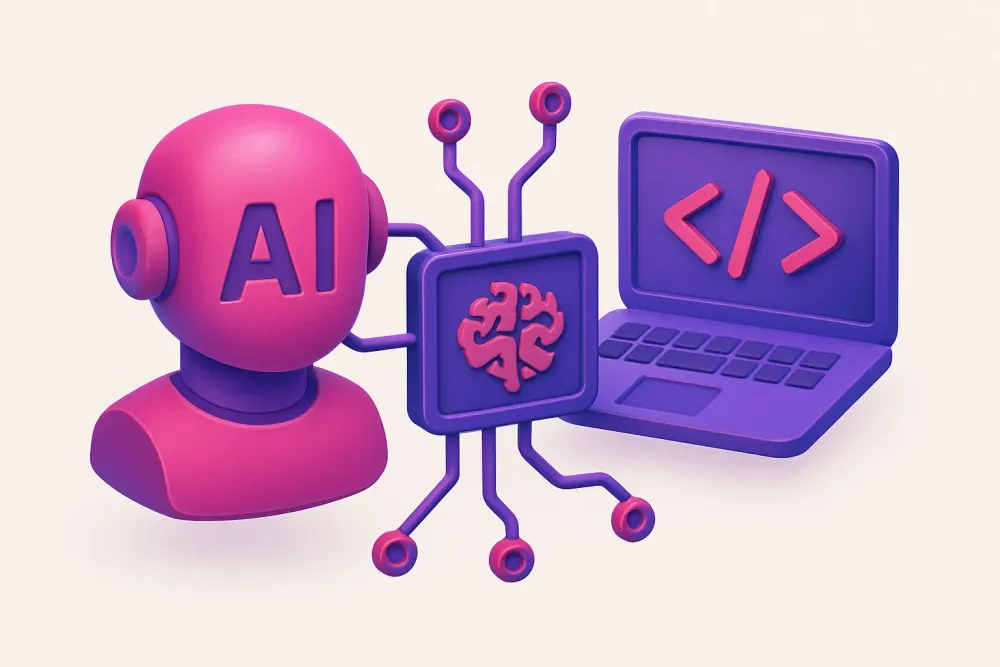
Revolutionizing Software Development: The Impact and Implications of AI
The software development landscape has undergone a dramatic transformation, largely fueled by the rapid integration of artificial intelligence (AI). This technological leap has fundamentally altered how developers build, test, and maintain applications. Gone are the days of solely relying on manual coding and protracted testing cycles. Modern developers now harness the power of AI-driven tools to automate repetitive tasks, proactively identify and resolve bugs, and significantly accelerate release timelines.
AI has seamlessly integrated into the daily operations of the software development lifecycle. Intelligent assistants, capable of generating code, executing tests, and even suggesting improvements continuously, are transforming the development process into one that is faster, more efficient, and demonstrably more reliable.
However, this paradigm shift presents both opportunities and challenges. While the advantages of AI in software development are substantial, its implementation necessitates careful consideration. Improper integration can lead to unforeseen errors, biases, or overlooked issues. Therefore, a thorough understanding of both the benefits and potential pitfalls is critical for successful AI adoption.
This in-depth analysis explores the transformative impact of AI on the software development industry. We will delve into its key applications, examine the advantages it offers, and address the challenges and risks organizations must navigate to leverage AI's full potential responsibly.
Artificial Intelligence: Reshaping Software Development
Artificial intelligence in software development leverages advanced technologies, including machine learning, natural language processing (NLP), and generative AI, to enhance speed, efficiency, and reliability. Instead of relying solely on manual coding, developers utilize AI-powered tools to automate routine tasks, generate code snippets, and detect potential issues early in the development process.
Machine learning empowers software to analyze extensive codebases, identifying patterns and predicting bugs before they escalate into significant problems. Natural language processing (NLP) allows tools to interpret plain English commands, facilitating the translation of simple instructions into functional code or documentation. Generative AI, exemplified by tools like GitHub Copilot and Tabnine, offers instant code suggestions, completes functions, and even generates entire modules based on limited textual input.
These AI-driven innovations are reshaping team dynamics. The 2023 Stack Overflow Developer Survey reported that over 70% of developers use AI tools to accelerate coding and debugging (source: Stack Overflow). Major platforms like Amazon's Kiro project and Microsoft's Azure AI demonstrate the transformative potential of automation in large-scale software delivery (Business Insider).
By synergistically integrating these AI technologies, development teams achieve greater efficiency. Repetitive tasks are automated, leading to cleaner code, fewer bugs, and a greater focus on creative problem-solving. In essence, AI in software development accelerates the transformation of innovative ideas into robust and reliable applications.
How Artificial Intelligence Contributes to Software Development
AI is revolutionizing the creation, testing, and management of software. It empowers developers to expedite tasks, detect bugs early, and produce higher-quality code. From automated testing to enhanced collaboration, here's how AI supports modern custom software development:
- Code Generation and Assistance: Numerous AI tools assist developers by providing code suggestions in real-time. These tools learn from extensive code libraries to offer instant suggestions, complete functions, and generate boilerplate code, significantly reducing the time spent on repetitive coding tasks and accelerating the learning curve for new developers.
- Automated Testing: AI-powered testing tools automatically generate test cases, identify edge scenarios, and execute software testing. These tools pinpoint areas requiring further attention, minimizing manual effort and enabling faster release cycles while ensuring the software functions as intended.
- Predictive Analytics: Predictive analytics enhances decision-making through data analysis. By analyzing historical development data, AI can predict project outcomes, anticipate potential delays, estimate task durations, and flag high-risk modules. These insights empower managers to optimize resource allocation and proactively address potential roadblocks.
- Debugging and Testing: AI tools meticulously scan code for bugs and suggest fixes, learning from past bug reports and user behavior to quickly identify root causes. This significantly reduces debugging time and enhances software stability, particularly crucial during rapid development cycles.
- Improved Code Quality: AI tools rigorously check code for adherence to best practices, style issues, and vulnerabilities, flagging potential performance bottlenecks or bugs. These intelligent code reviewers collaborate with developers, offering suggestions that enhance reliability, reduce technical debt, and maintain clean, maintainable codebases over time.
- Enhanced Collaboration: AI facilitates seamless teamwork by providing real-time suggestions in shared workspaces, translating code comments, summarizing tasks, and aligning team goals. By automating documentation and minimizing miscommunication, AI fosters smooth collaboration, even across geographically dispersed teams and time zones.
- Project Management: AI tools seamlessly monitor project progress, assisting with task planning, deadline assignment, and workload balancing. They alert teams to potential delays, prioritize features based on user feedback, and provide a clear overview of project status, ensuring timely and budget-conscious delivery.
Benefits of Using AI in Software Development
Integrating AI into software development offers numerous advantages, including accelerated development processes, automated task completion, enhanced code accuracy, and improved decision-making. When implemented effectively, AI boosts productivity, strengthens collaboration, and results in higher-quality software with reduced bugs and faster release cycles. The key benefits are:
- Faster Development Process: AI tools assist developers by generating code, completing functions, and automating common tasks, significantly reducing time spent on routine activities and accelerating the overall development timeline. This enables quicker responses to market demands and faster delivery of updates and new features.
- Improved Code Quality: AI technologies efficiently review code for bugs, syntax errors, and logical inconsistencies, ensuring adherence to coding standards. These automated checks minimize technical debt and enhance maintainability, leading to improved software performance and reduced runtime issues.
- Enhanced Testing and QA: AI-powered testing tools automatically generate test cases, simulate user behavior, and detect bugs, minimizing manual testing intervention. Continuous testing identifies issues early, resulting in fewer post-release defects and increased user satisfaction.
- Better Project Management: AI assists managers in planning sprints, allocating resources, and predicting delivery timelines by analyzing historical project data to identify patterns and risks. This results in more accurate scheduling, reduced delays, and improved alignment with budgets, goals, and customer expectations.
- Cost Efficiency: By automating tasks such as code generation, bug detection, and testing, AI reduces the need for manual effort, cutting down on development hours and operational costs. This translates to long-term cost savings while delivering superior software quality.
- Increased Productivity: With AI handling repetitive and time-consuming tasks, developers can focus on complex problem-solving and innovation, leading to increased job satisfaction and faster project progress.
Challenges of Integrating AI in Software Development
While AI integration offers significant benefits, organizations face several challenges, including setup costs, data management complexities, and staff training requirements. Addressing these challenges proactively ensures that AI tools deliver tangible benefits without causing major setbacks:
- High Initial Investment: Implementing AI tools often requires substantial investments in licenses, cloud infrastructure, and expert consultation. Smaller development teams might struggle to justify the initial expense, potentially delaying adoption.
- Data Quality Requirements: AI's effectiveness relies on high-quality, relevant, and properly labeled data. Incomplete, outdated, or biased data can lead to inaccurate or unreliable AI outputs, necessitating ongoing data management efforts.
- Skill Gap: Utilizing AI tools often necessitates new skills in machine learning, model tuning, or data science. Developers may require training to become proficient with these new platforms, which can impact immediate productivity.
- Complex Tool Integration: AI platforms might not seamlessly integrate with existing development environments, requiring custom coding, plugin setups, or adjustments to CI/CD pipelines. This integration complexity can hinder progress, especially when documentation or support is lacking.
- Trust and Accuracy: AI-generated suggestions or code snippets aren't always flawless. Developers must carefully review AI outputs to prevent errors. Blind reliance on AI can lead to faulty implementations.
- Maintenance Overhead: AI tools require ongoing updates, model retraining, and adaptation to evolving codebases and user needs. This ongoing maintenance can add to the overall workload.
Risks of AI in Software Development
Despite the advantages of AI, several risks must be acknowledged and mitigated. These risks span technical, ethical, and strategic domains. Without careful oversight, AI can lead to biased, insecure, or unreliable systems, potentially harming users or damaging reputations:
- Bias and Fairness Issues: AI models trained on biased historical data can produce unfair outcomes, potentially leading to discrimination and ethical concerns.
- Security Vulnerabilities: Poorly configured or outdated AI tools can introduce security vulnerabilities, exposing applications to cyber threats.
- Overreliance on Automation: Excessive reliance on AI can diminish human judgment and lead to critical oversights.
- Unexpected Behaviors: AI-generated code might function correctly in most cases but fail under unexpected conditions, leading to disruptions in production.
- Legal and Compliance Concerns: AI tools may process user data or rely on licensed datasets, potentially violating privacy laws or licensing agreements.
- Vendor Lock-in: Overdependence on a single AI vendor can create difficulties in transitioning to alternative providers in the future.
Conclusion
The integration of AI into software development has undeniably brought significant improvements, accelerating development processes, reducing errors, and enhancing software quality. AI supports virtually every stage of the development lifecycle, from planning to deployment. However, it's crucial to acknowledge the associated challenges and risks. Issues like bias, data quality, and security demand careful management. A balanced approach, combining human oversight with the capabilities of AI tools, is essential for responsible and effective AI implementation. Understanding both the advantages and limitations is pivotal for harnessing the full potential of AI in software development while mitigating potential risks.
See More
Contact Us
Let’s make your Idea into Reality
Let's Talk

© Copyright DEFX. All Rights Reserved
GoodFirms ★ 4.2
Clutch ★ 4.2
Google ★ 4.2