
Home
Services
Products
Projects
Who We Are
Blogs
Contact Us
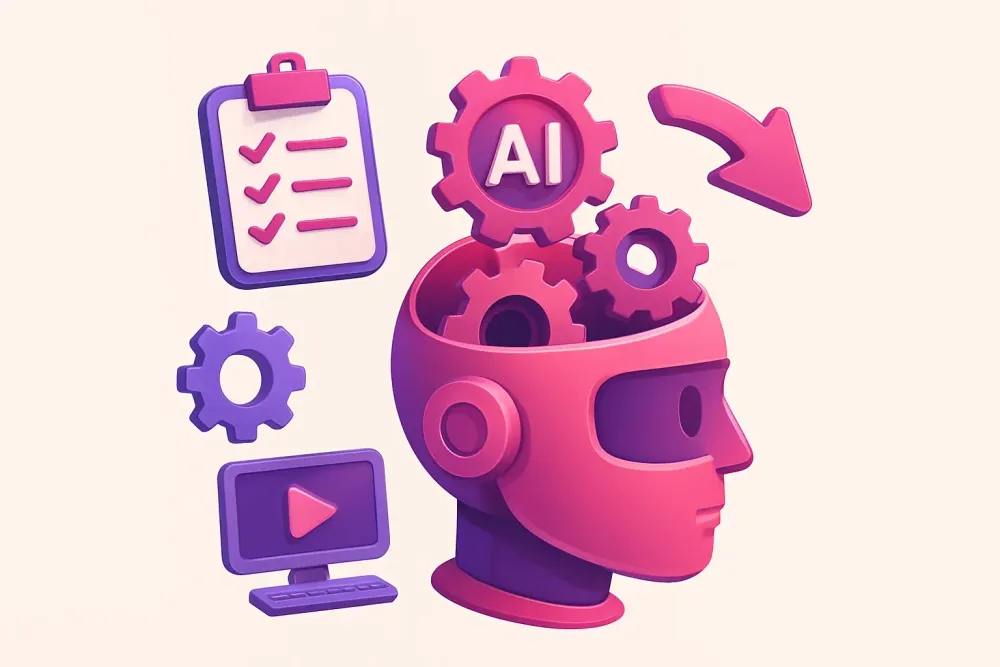
Revolutionizing Your Workflow: The Power of AI Automation
Manual tasks are inherently slow, prone to errors, and consume excessive time, frequently creating bottlenecks and delaying project completion. Employees burdened with repetitive manual work are often unable to dedicate their skills to higher-value activities directly contributing to revenue. A study by Formstack and Mantis Research indicates that manual and paper-based workflows can result in revenue losses of up to $1.3 million annually. This not only impacts businesses with reduced revenue and increased operational costs but also leads to employee dissatisfaction and decreased motivation.
AI-powered workflow automation offers a powerful solution, acting as a lifeline for businesses facing these challenges. By automating crucial yet low-skill tasks, minimizing operational errors, and streamlining processes, AI empowers businesses to maintain a competitive edge while optimizing operational expenses. This article will explore the significance, practical applications, and benefits of AI in workflow automation, providing a comprehensive guide to implementation.
What is AI Workflow Automation?
AI workflow automation leverages Artificial Intelligence (AI) to streamline and optimize existing business processes, particularly those that are manual and repetitive. This process frees human resources for complex and strategic tasks, maximizing their potential.
AI workflow automation employs algorithms, machine learning, deep learning, data analysis, and other technologies to orchestrate and automate time-consuming processes. These AI-powered tools effectively replicate human intelligence and decision-making capabilities, ensuring task completion with exceptional precision and accuracy.
It’s crucial to understand the key differences between AI workflow automation and traditional automation:
- Adaptability: Traditional automation relies on pre-programmed rules, while AI workflow automation learns from data and adapts to changing circumstances.
- Decision-Making: Traditional automation makes simple, binary decisions based on clear rules, whereas AI automation handles complex scenarios and makes nuanced judgments.
- Data Processing: Traditional automation typically works with text data, while AI workflow automation processes multimodal data including text, images, audio, and video.
- Evolution: Traditional automation remains static unless manually updated, whereas AI automation continuously improves through machine learning.
- Interaction: Traditional automation lacks natural language processing (NLP) capabilities, while AI automation facilitates human-like interactions using NLP.
- Task Complexity: Traditional automation excels at rule-based tasks; AI automation handles reasoning, problem-solving, and decision-making tasks.
A prime example of AI workflow automation is data entry. Manually collecting, sorting, and analyzing data is tedious and error-prone. AI agents can ingest large datasets, classify data, generate reports, and distribute information across teams — all without human intervention.
Benefits of AI in Workflow Automation
AI eliminates workflow bottlenecks that have long hindered business operations. Key benefits include:
- Increased Efficiency: AI can boost operational efficiency by 10–50% by automating data entry, form processing, scheduling, and routine communication.
- Strategic Use of Human Expertise: By taking over repetitive tasks, AI enables employees to focus on innovation, customer engagement, and strategic decisions.
- Reduced Operational Errors: Manual workflows can average 50 errors per day. AI automation significantly reduces this through machine learning and predefined rules.
- Faster Time-to-Market: AI streamlines workflows, enabling quicker product ideation and development. Developers can automate repetitive coding tasks to focus on UX and testing.
- Scalability & Resource Optimization: AI systems scale instantly without training or onboarding, making them ideal for fluctuating workloads.
- Improved Compliance: AI ensures accurate data entry and reduces non-compliance risks in regulated industries.
- Reduced Operational Costs: AI minimizes dependency on human resources and reduces costs by automating roles like customer care, support, and administrative tasks.
Types of AI Workflow Automation
- RPA + AI – Combines rule-based automation with intelligence.
- Document Automation – Extracts and processes large volumes of structured and unstructured documents.
- Conversational AI – NLP-powered assistants for customer support and internal operations.
- Predictive Analytics Automation – Predicts trends using machine learning.
- Cognitive Workflow Automation – Mimics human reasoning for complex decisions.
- Computer Vision Automation – Interprets and analyzes images or video.
- Autonomous Systems – Fully independent AI-driven machines.
- Natural Language Generation (NLG) – Automates report writing and content creation.
Use Cases Across Industries
- Healthcare: Medical records automation, patient data classification, insurance processing, predictive analytics, medical imaging QA.
- Retail: Customer service automation, personalized recommendations, sentiment analysis, sales forecasting, checkout assistance.
- Finance: Automated market analysis, risk assessment, fraud detection, document processing, customer service workflows.
- Human Resources: Resume scanning, interview scheduling, onboarding automation, employee engagement analysis.
- Manufacturing: Production monitoring, predictive maintenance, defect detection, supply chain optimization.
- Supply Chain & Logistics: Route optimization, demand prediction, quality control, GPS-based dynamic scheduling.
Challenges in AI Workflow Automation
- Data quality and availability
- Legacy system integration
- High initial investment
- Regulatory and compliance complexities
- Explainability limitations
- Ongoing model maintenance and retraining requirements
How DEFX Can Help You Implement AI Workflow Automation
DEFX provides customized AI workflow automation solutions tailored to industry-specific needs. Our AI experts build solutions ranging from conversational AI agents to predictive analytics systems — all designed to automate routine tasks, optimize resources, enhance accuracy, and reduce operational costs.
We use advanced machine learning, analytics, NLP, and intelligent automation to help businesses scale seamlessly and operate more efficiently. Whether it's automating customer support, document processing, or operational workflows, DEFX delivers solutions that drive measurable impact.
Contact DEFX today for a free consultation and discover how AI can transform your workflows.
See More
Contact Us
Let’s make your Idea into Reality
Let's Talk

© Copyright DEFX. All Rights Reserved
GoodFirms ★ 4.2
Clutch ★ 4.2
Google ★ 4.2